The Focus Is in the Wrong Place
Most conversations about drones start with the aircraft. Teams evaluate flight time, sensors, payload capacity, and range, assuming those factors define success. While those specifications matter, they do not determine whether a deployment will actually deliver value over time.
The reality is that many drone deployments fail even when the aircraft performs exactly as expected. The failure does not happen at takeoff, and it is not always obvious when it occurs. It happens quietly, as the system begins to fall short of real-world demands.
The Failure Point No One Plans For
A drone can launch, remain stable, and collect data, but that alone does not make a deployment successful. The real measure of performance is whether the system can sustain operations under changing conditions while continuing to support the payload and deliver usable information.
This is where the silent failure point appears. It is not a single event. It is a gradual breakdown in the system’s ability to maintain power, move data reliably, and support the payload for the duration required.
Over time, small limitations begin to compound. Power becomes inconsistent. Data transfer slows or drops. The system struggles to keep up with the demands placed on it. By the time the issue is recognized, the value of the deployment has already been reduced.
Why Payloads Expose the Gap
Payloads are often the most overlooked factor in drone performance. As payload requirements increase, so does the strain on the system supporting the aircraft.
Heavier sensors, communications equipment, and ISR payloads demand more power and more stability. In battery dependent systems, this directly reduces mission duration. The more capable the payload, the faster the system reaches its limits.
This is where many deployments begin to break down. The drone itself may still be capable, but the system can no longer sustain the payload effectively. Performance becomes inconsistent, and the reliability of the data begins to decline.
The Role of Tethered Drone Systems
This is where tethered drone systems change the conversation. A tethered drone is not simply an aircraft connected to a power source. It is part of a larger system designed to address the limitations that cause most deployments to fail.
Tethered drones provide continuous power from the ground, allowing the aircraft to support heavier payloads for extended periods without the constraints of onboard batteries. At the same time, the tether can support secure, high bandwidth data transfer, ensuring that information moves reliably from air to ground.
This combination of sustained power and consistent data flow allows tethered drone systems to maintain performance over time, even as payload demands increase and conditions change.
Where the LEAP Product Line Fits
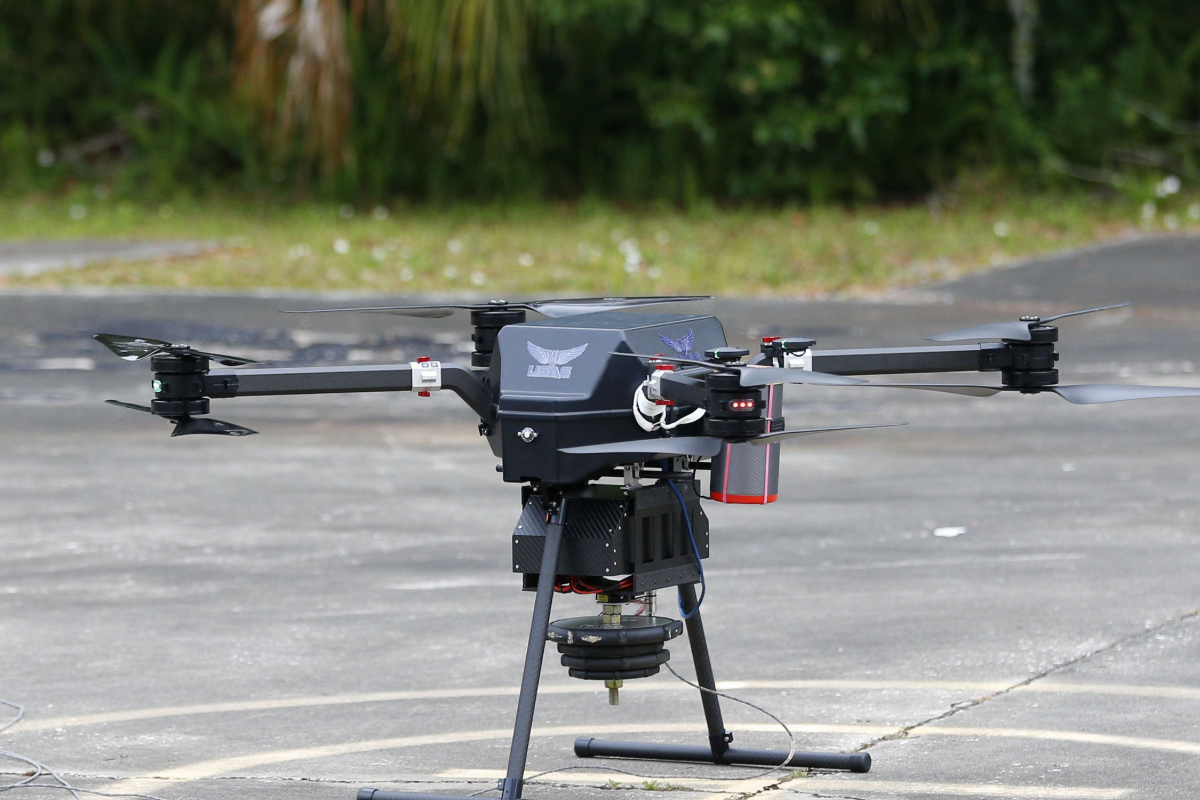
The LEAP product line is designed around the idea that a drone is only one part of a complete system. Each platform focuses on sustaining performance, not just enabling flight.
LEAP Tactical is built for rapid deployment and high mobility. It provides a compact tethered drone system for Group 1 drones, delivering power for both the aircraft and its payload while maintaining flexibility in dynamic environments. While USaS can provide the drone as part of the system, LEAP Tactical is also designed to integrate with a wide range of customer supplied drones.
LEAP Solo 5K is a heavy lift tethered drone system designed for extended use. It delivers 5kW of continuous power and supports payloads up to 21 pounds, enabling reliable performance for ISR, communications, and other mission critical applications. Like the rest of the LEAP product line, the system is designed to work with a broad range of drone platforms based on mission requirements.
LEAP Solo 10K expands that capability with 10kW of power and support for payloads up to 50 pounds. It is built for environments where payload requirements are more demanding and sustained performance is essential.
LEAP Solo 20K extends the system even further, delivering 20kW of power and supporting payloads up to 150 pounds. This level of capability allows teams to deploy larger, more complex payloads without sacrificing endurance or reliability.
Across the entire product line, the focus remains consistent. Provide continuous power, support real payloads, and maintain secure, high bandwidth data transfer so the system performs as expected over time.
The Difference Between Activity and Outcome
Flying a drone creates activity. Sustaining performance creates outcomes.
The silent failure point exists in the gap between those two. It is the difference between collecting data and delivering information that can actually be used. It is the difference between short term visibility and long term capability.
Teams that focus only on the aircraft often encounter this gap without realizing it. Teams that focus on the system are able to close it.
Final Thought
The drone is not the limiting factor in most deployments. The system is.
Tethered drones and tethered drone systems address that limitation by connecting power, payload support, and data into a single, continuous capability. For teams that rely on drones to deliver real results, that system level approach is what prevents the silent failure point from becoming a mission failure.