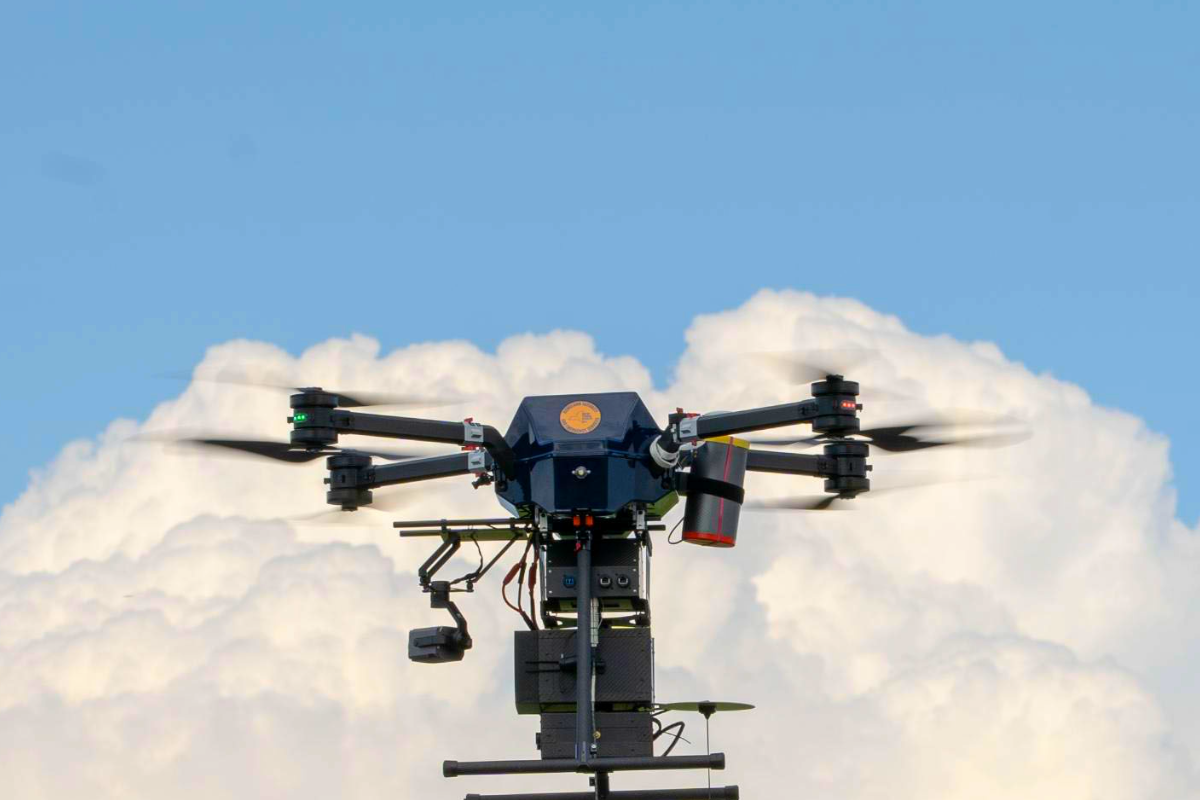
For years, drone operations have largely been shaped by one unavoidable limitation: time in the air.
You can build a capable aircraft. You can integrate sophisticated sensors, communications equipment, cameras, and other payloads. But if the aircraft has to repeatedly return to the ground for battery changes, everything happening above it is ultimately constrained by endurance.
Tethered UAS change that equation.
At Unmanned Systems and Solutions (USaS), we have spent years developing systems around a relatively simple idea: what becomes possible when an aircraft can stay hundreds of feet above the ground for extended periods of time?
The answer is more than longer flight time.
It changes how we think about the entire operation.
400 Feet Is More Than Altitude
Getting a payload to 400 feet AGL creates something difficult to replicate from the ground: elevation that can remain available.
At that height, communications equipment can gain improved line of sight. Sensors can observe a much larger area. Networking equipment can establish an elevated node. ISR payloads can maintain persistent overwatch without an aircraft repeatedly cycling between the air and the ground.
The value is not simply reaching 400 feet.
It is staying there.
A conventional battery-powered aircraft may be able to reach the same altitude quickly, but every minute in the air consumes a finite resource. Eventually, the aircraft has to come down.
A tethered system approaches the problem differently by supplying continuous power from the ground.
That distinction has shaped the way we design the entire LEAP product line.
The Ground Power Station Changes the Equation
The aircraft gets most of the attention, but a tethered UAS is only as useful as the infrastructure supporting it.
For USaS, the ground power station is not simply something that provides electricity through the tether.
It can become the foundation of the operation.
Continuous ground power allows the aircraft and its payloads to remain elevated for extended periods without repeatedly landing for battery changes. Our LEAP systems are designed around 24-hour operating segments, giving operators the ability to maintain an elevated capability far longer than a traditional battery cycle would allow.
But power is only part of the equation.
The ground station can also serve as a hub for backhaul, connecting the elevated payload to communications infrastructure such as LEO satellite, GEO satellite, fiber, microwave, and other networks.
That means the system can do more than put technology in the air.
It can help connect what is happening at 400 feet to everything happening beyond it.
One Altitude. Very Different Capabilities.
There is no single reason to put something 400 feet in the air.
That is exactly why we have developed LEAP as a product line rather than a single tethered aircraft.
LEAP Solo 5K provides 5 kW of power with support for up to a 21-pound payload and 20 Gbps data capability.
LEAP Solo 10K increases that capacity to 10 kW and supports payloads up to 50 pounds while maintaining the same 400-foot operating altitude and high-bandwidth data capability.
For operations requiring more than an aircraft and ground power station, LEAP Team expands the system with supporting infrastructure including power generation, satellite connectivity, climate control, and an integrated 22-foot mast.
LEAP Command adds an enclosed command-and-control environment, creating a more complete operational package around the elevated platform.
And when speed and portability matter, LEAP Tactical takes a different approach. The system is designed for deployment and retrieval within approximately 10 minutes, with four hours of operation on its internal battery and the ability to extend operation when connected to external power.
Different configurations. Different operational requirements.
The same fundamental advantage: persistent capability above the ground.
Persistence Changes What You Can Ask a Drone to Do
When endurance stops being the dominant constraint, the questions begin to change.
Instead of asking, How long can we keep this payload airborne?
You can start asking, What can we accomplish if it stays there?
Can it provide persistent ISR over an area for hours at a time?
Can it elevate communications equipment where existing infrastructure is limited?
Can it create an elevated network node?
Can multiple payloads operate simultaneously from the same platform?
Can the ground station connect those payloads directly into existing communications infrastructure?
Those are fundamentally different questions from the ones that shaped many traditional drone operations.
And that is why 400 feet matters.
The Bigger Change Is on the Ground
It is easy to look at a tethered drone and focus on the aircraft overhead.
We look at the entire system.
The aircraft provides the elevation. The tether provides continuous power and data. The ground power station supports persistence and connectivity. The surrounding infrastructure determines how effectively that elevated capability can be used.
Together, those components turn altitude into something much more useful: infrastructure that can be deployed where it is needed and remain available for extended periods.
That is what has changed the way we think about drone operations.
The opportunity is not simply to fly higher or longer.
It is to make 400 feet of persistent, connected airspace part of the operation itself.