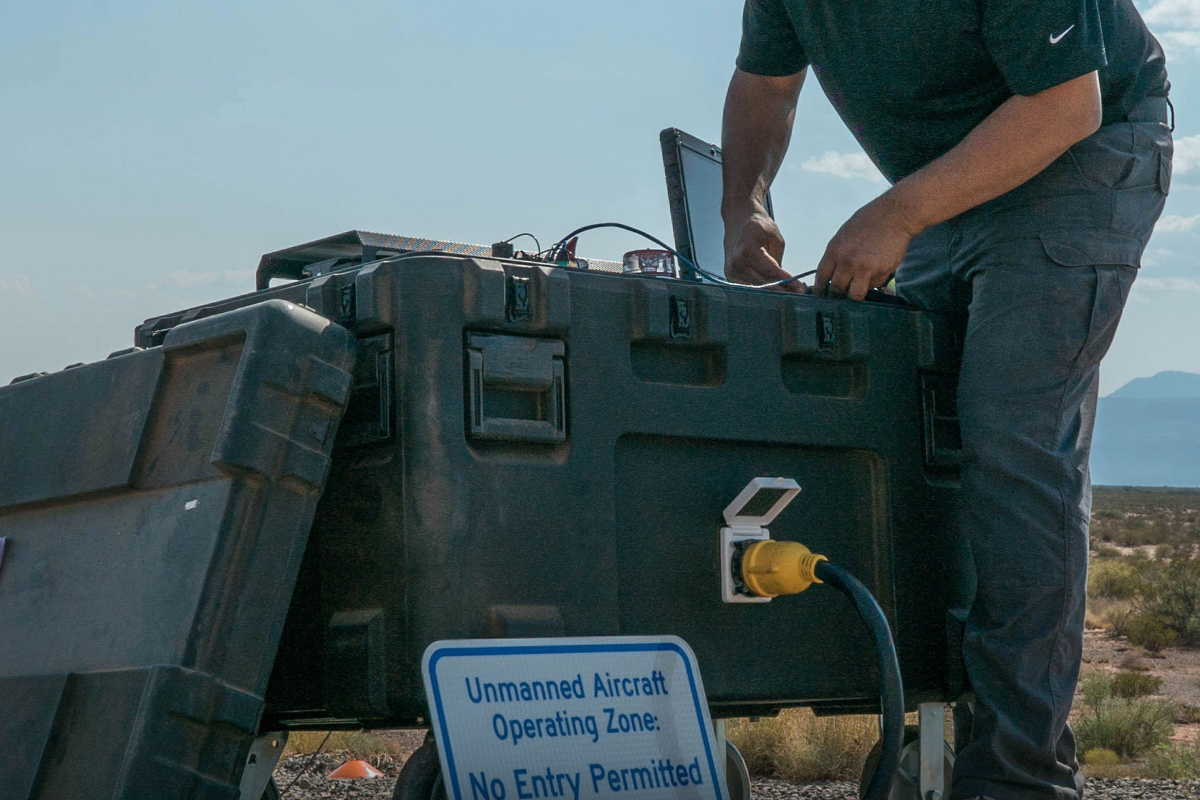
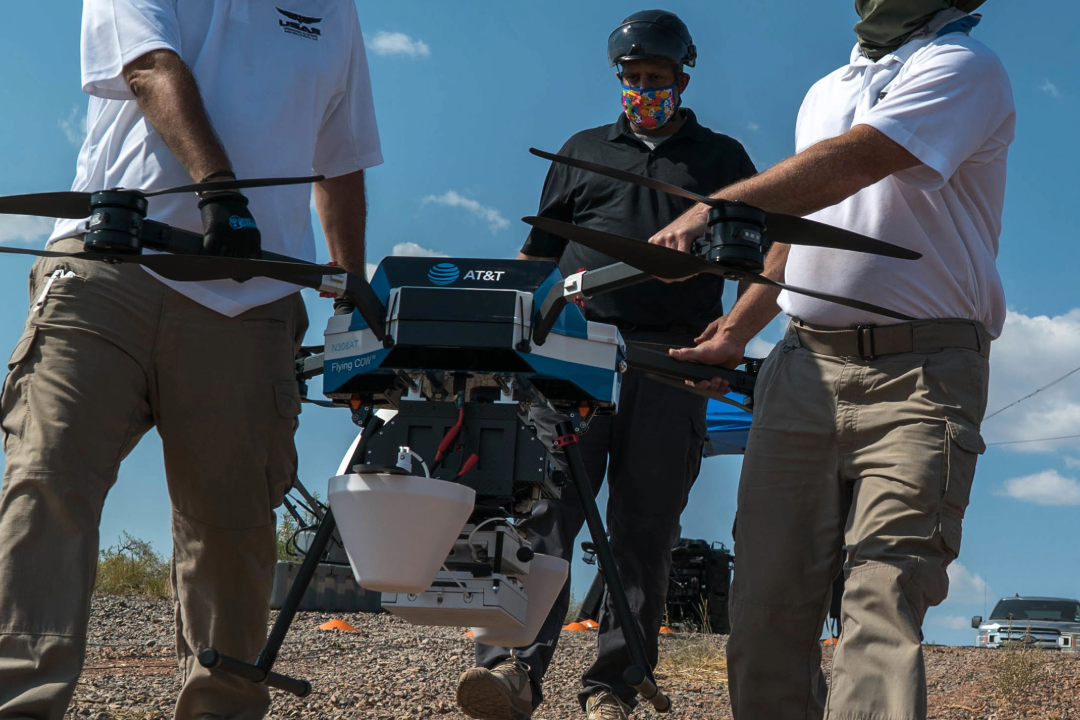
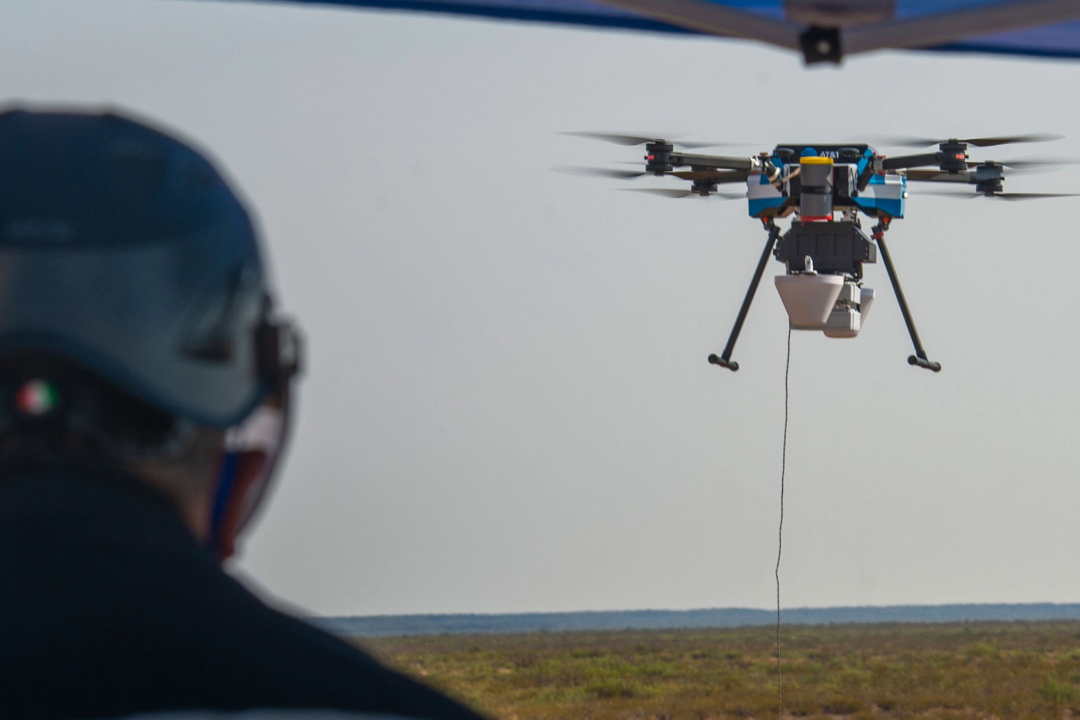
When people think about tethered drones, the ground station is usually viewed as a power source.
That is certainly one of its most important functions. Continuous power from the ground allows an aircraft and its payloads to remain elevated for extended periods without repeatedly landing for battery changes.
But at Unmanned Systems and Solutions (USaS), the ground power station can do more than keep the aircraft in the air. It can also serve as a hub for backhaul.
That means the same system supporting the aircraft overhead can provide the connection point to LEO satellite, GEO satellite, fiber, microwave, and other communications infrastructure.
For many applications, that connection is just as important as the power itself.
Getting the Payload Up Is Only Half the Job
Tethered UAS can elevate communications equipment, ISR sensors, tactical radios, networking hardware, and other payloads hundreds of feet above the ground.
That elevation creates an immediate advantage. Communications equipment can gain greater reach. Sensors gain a persistent elevated vantage point. Network equipment can be positioned above terrain, structures, or other obstacles that would limit capability at ground level.
But getting the payload into position is only the first step.
Where does the information go once the payload is operating?
An elevated camera needs a way to deliver video to users on the ground or at a remote location. A communications payload needs to connect into a broader network. An airborne LTE or 5G node needs backhaul to connect users to infrastructure beyond the immediate coverage area.
Without that connection, you may have valuable capability in the air without an effective way to move its data where it needs to go.
That is why the ground station matters.
The Ground Station Becomes Part of the Network
Instead of thinking about a tethered UAS as simply an aircraft connected to a power source, the architecture can be viewed as a complete chain:
Payload → Aircraft → Tether → Ground Station → Backhaul → Network
USaS designed the LEAP architecture around this larger system. LEAP electronics and tether modules provide power to the aircraft and payloads, route signals and data, manage the tether, and facilitate backhaul. The proprietary tether itself can provide both power and fiber for data.
The ground power station therefore becomes much more than the equipment keeping the aircraft airborne.
It can become the point where an elevated payload connects to LEO satellite, GEO satellite, fiber, microwave, or other available communications pathways.
Power and connectivity become parts of the same deployable architecture.
Different Deployments Need Different Backhaul
There is no single backhaul method that makes sense everywhere.
A deployment near established infrastructure may be able to connect through fiber. Another location may be better served by microwave. Remote locations may require satellite communications. In a disaster environment, the terrestrial infrastructure normally used to move data may be damaged, overloaded, or unavailable.
The requirement can change from one deployment to the next, which makes the ability to support different backhaul pathways increasingly important.
This is particularly valuable in situations where tethered UAS are being used as temporary or rapidly deployable infrastructure.
Rather than relying on one fixed communications pathway, the ground station can serve as the hub between the elevated capability and whichever backhaul solution is appropriate for the deployment.
The aircraft provides elevation. The tether provides persistent power and data connectivity. The ground station connects that capability to the wider network.
Together, those pieces make a tethered UAS much more than an aircraft capable of staying airborne for a long time.
LEAP Solo: Power, Payload and Connectivity
The USaS LEAP Solo product line was developed around this system-level approach.
The LEAP Solo 5K provides 5 kW of power for the aircraft and payloads, supports up to 21 pounds of customer payload, and provides 20 Gbps secure data transfer. The system has already been used in communications applications by organizations including AT&T and T-Mobile.
For applications requiring greater payload capacity and power, LEAP Solo 10K scales the architecture upward with 10 kW available for the aircraft and payloads while maintaining high-capacity secure data transfer.
And LEAP Solo 20K extends the concept into ultra-heavy-lift applications, providing 20 kW of power for the aircraft and payloads and supporting payloads up to 150 pounds according to USaS product materials.
These systems aren’t designed around flight endurance alone.
They are designed to keep substantial capability elevated, supply the power that capability requires, move data between the air and ground, and provide a point from which that capability can connect into the wider communications network.
LEAP Tactical Brings the Same Concept to a Mobile System
The same philosophy extends to LEAP Tactical, USaS’s smaller and more mobile tethered UAS platform.
LEAP Tactical can deploy and retrieve within 10 minutes and operate up to 400 feet AGL. Its available backhaul options include LTE/5G, LEO satellite, and MN-MIMO tactical radios.
The Cloak configuration adds another dimension by moving command-and-control and payload data through fiber in the tether. This allows the aircraft to operate without an air-to-ground RF connection for those functions while still providing a pathway for data back to the ground system.
It is a smaller platform serving different requirements, but the principle remains the same: the value of a tethered system is not limited to how long it can remain airborne.
More Than a Power Station
The endurance advantage of tethered UAS is significant, especially as aircraft are asked to carry heavier and more power-hungry payloads.
But endurance is only part of the equation.
The payload needs power. Its information needs to reach the ground. And in many applications, that information then needs to travel far beyond the deployment site.
That is why the ground power station should be viewed as a critical part of the overall communications architecture.
It can keep the aircraft and payload operating while also serving as a hub connecting that elevated capability to LEO satellite, GEO satellite, fiber, microwave, and other backhaul infrastructure.
At USaS, the goal isn’t simply to keep a drone in the sky longer.
The LEAP product line is built to keep useful capability elevated, powered, connected, and integrated into the networks that need it.