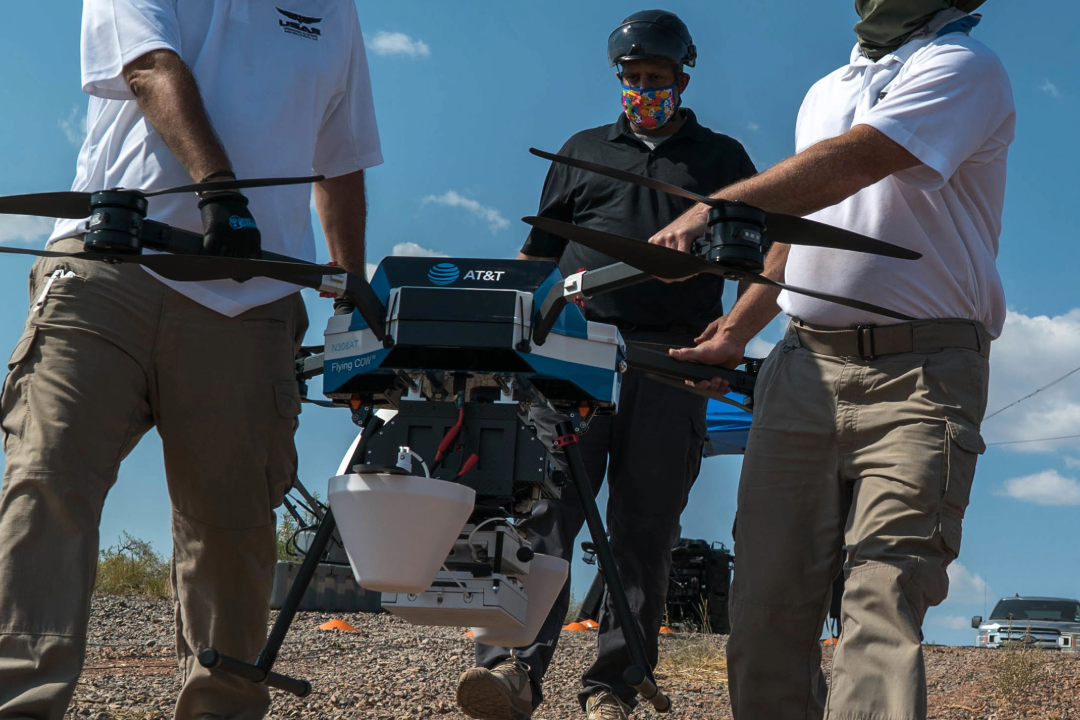
For most drone operations, radio frequency communication is simply assumed.
The aircraft goes up. Commands travel wirelessly between the operator and the UAV. Data comes back down. As long as that connection remains available, the system works as intended.
But what happens when relying on RF becomes the problem?
That question was part of the thinking behind LEAP Tactical, USaS’s highly mobile tethered drone system designed for Group 1 UAVs. Rather than building a system around one communications architecture, LEAP Tactical was designed with different configurations for different operating requirements, including an option that can move command, control, and payload data through the tether itself.
LEAP Tactical Was Designed for More Than One Scenario
LEAP Tactical is contained in a hardshell case with the tether system, 400 feet of tether, and a UAV. It is designed to deploy and retrieve within 10 minutes and can be configured in three different ways: Overwatch, Pursuit, and Cloak.
Each configuration approaches mobility and communications differently.
Overwatch provides a portable tethered platform capable of maintaining ISR and communications payloads on station up to 400 feet AGL. Payload data can also be backhauled to remote sites and command centers through optional high-bandwidth secure data links.
Pursuit adds the ability to disengage from the tether and pursue a target for up to 50 minutes before returning to the tethered operating model.
Then there is Cloak.
When You Don’t Want to Rely on Air-to-Ground RF
LEAP Tactical Cloak takes a different approach to communication between the aircraft and the ground.
Its hybrid tether incorporates fiber optic cable, allowing command and control signals and payload data to travel between the aircraft and ground through the tether at more than 1 Gbps.
That eliminates the need for air-to-ground RF communications.
According to the LEAP Tactical specifications, this allows Cloak to operate in RF-contested environments or in situations where propagating an RF signature could be dangerous.
That distinction is important.
A tether is often viewed primarily as a way to provide continuous power. But in LEAP Tactical Cloak, the physical connection between the aircraft and ground can also become the communications pathway.
Power, command and control, and payload data no longer have to be treated as completely separate problems.
The Connection Matters as Much as the Aircraft
Putting an aircraft 400 feet above the ground is only useful if the operator can control it and receive what its payload is collecting.
That is why communications are built into the LEAP Tactical architecture rather than treated as an afterthought.
LEAP Tactical supports UAV command and control and payload data transfer through secured wireless RF or through the tether, depending on the configuration. It can also support backhaul through LTE/5G, LEO satellite such as Starlink, and tactical radios.
That creates two different communications questions.
The first is how the aircraft communicates with the ground system. The second is how information from the system gets where it ultimately needs to go.
LEAP Tactical was designed with both in mind.
For Cloak specifically, the hybrid tether provides the connection between the aircraft and the ground. When permitted, payload data can then be backhauled from the ground system to remote sites or command centers using optional secure data links.
In other words, eliminating the need for an air-to-ground RF connection does not eliminate the ability to move information beyond the immediate operating location.
A Tether Can Solve More Than One Constraint
The same design philosophy applies to power.
LEAP Tactical can operate for up to four hours using its optional battery power pack or for an unlimited amount of time when connected to an external power source such as 120VAC, a vehicle, vessel, or other compatible external supply.
So the tether is not serving a single purpose.
Depending on the LEAP Tactical configuration, it can support the aircraft with power, provide a physical pathway for command and control, and carry payload data between the aircraft and ground.
That changes what the tether represents within the overall system.
Instead of simply being the cable that keeps a drone powered, it becomes part of the infrastructure connecting the aircraft, its payload, the operator, and potentially a remote command center.
Different Environments Create Different Requirements
There is no single configuration that makes sense for every drone operation. Sometimes the priority is keeping an aircraft and payload elevated for an extended period. Sometimes an operator needs the ability to leave the tether and pursue a target. And sometimes maintaining an air-to-ground RF connection is itself undesirable.
That is why LEAP Tactical was developed around three configurations rather than a single operating model.
Overwatch focuses on persistent tethered operation. Pursuit adds the ability to transition from tethered overwatch into untethered movement. Cloak maintains the tether but changes what can travel through it by adding fiber for command, control, and payload data.
The aircraft may be similar, but the way the system communicates and operates can change based on what the environment requires.
The Tether Can Do More Than Supply Power
This idea extends beyond Cloak.
LEAP Tactical can support UAV command and control and payload data transfer wirelessly or through the tether, while backhaul options include LTE/5G, LEO satellite and tactical radios. External power can also be used to extend flight time beyond battery-only operation.
The result is a system designed around more than simply getting a drone into the air.
It is about maintaining the aircraft, keeping useful payloads elevated, moving the data those payloads generate, and giving operators different ways to establish the connections they need.
What Happens When RF Is the Problem?
It doesn’t necessarily mean the aircraft has to come down.
With LEAP Tactical Cloak, command and control and payload data can continue moving through the fiber-optic tether without requiring an air-to-ground RF connection.
That is the larger idea behind LEAP Tactical.
Overwatch when you need persistent elevation. Pursuit when you need mobility beyond the tether. Cloak when air-to-ground RF isn’t the connection you want to depend on.
Three configurations built around a simple reality: the operating environment does not always cooperate with the assumptions made when a drone system was designed.