The drone industry has spent years working toward a future where aircraft can do more with less human involvement. Autonomous navigation, automated flight planning, obstacle avoidance, and increasingly sophisticated artificial intelligence have become major selling points for unmanned aerial systems.
And for good reason. These advancements are changing what drones are capable of accomplishing, particularly in environments where human intervention is difficult, dangerous, or inefficient.
But as the industry continues to invest in making drones more autonomous, there is another question worth asking.
Are we solving the problems operators actually face, or are we simply making aircraft more technologically advanced?
At Unmanned Systems and Solutions (USaS), nearly a decade of experience developing and deploying tethered unmanned aerial systems has shaped how we think about that question.
We’ve seen firsthand that the most valuable advancement isn’t always the one that makes an aircraft more independent. Sometimes, it’s the one that makes the entire system more dependable.
The Difference Between What a Drone Can Do and What an Operator Needs
There is a tendency in the technology industry to measure progress by the number of tasks a system can perform without human involvement.
Can the aircraft take off on its own? Can it navigate a predetermined route? Can it identify objects, adjust its position, and return to its starting point without direct pilot input?
These are impressive capabilities, and they have legitimate applications across defense, public safety, commercial operations, and infrastructure inspection.
But consider what happens when the operational requirement is much simpler.
A first responder needs an elevated view of an area for several hours. A telecommunications provider needs to maintain coverage while damaged infrastructure is restored. A security team needs continuous surveillance of a fixed location. A military unit needs communications equipment positioned above ground-level obstructions.
In these situations, the primary challenge isn’t necessarily getting the aircraft to navigate independently.
It’s keeping the right equipment in the right position, with reliable power and communications, for as long as it’s needed.
An aircraft could have the most sophisticated autonomous navigation system available and still be limited by its power supply, payload capacity, or ability to transmit information.
That distinction matters because operators don’t purchase technology simply to demonstrate what it can do. They depend on it to accomplish a specific objective.
Autonomy Doesn’t Eliminate the Limitations of the Aircraft
Imagine an autonomous drone capable of taking off, navigating to a designated position, identifying objects, and returning to its launch point without intervention.
Now imagine that same aircraft is carrying a substantial communications or surveillance payload.
The additional weight increases power consumption, reducing the time the aircraft can remain airborne. Eventually, regardless of how intelligent its onboard systems are, it must return to the ground to recharge or replace its batteries.
For certain applications, that interruption may be acceptable.
For others, it creates a significant operational problem.
Every landing introduces a potential gap in coverage. Every battery replacement requires additional equipment, personnel, or infrastructure. Every interruption forces operators to account for what happens while the aircraft is unavailable.
Autonomy can help manage these transitions, but it doesn’t eliminate the underlying physical limitations.
This becomes particularly important as payload requirements increase.
A lightweight drone carrying a small camera has very different power requirements than an aircraft supporting tactical radios, communications equipment, networking hardware, or multiple sensors.
As the payload becomes more demanding, the relationship between power, endurance, and operational capability becomes increasingly important.
The aircraft may be able to make more decisions on its own, but that doesn’t necessarily mean it can stay in the air long enough to complete the job.
Sometimes the Most Valuable Capability Is Staying Put
Much of the conversation surrounding autonomous drones focuses on movement.
How far can the aircraft travel? How effectively can it navigate? How quickly can it respond to changes in its environment?
But some of the most valuable applications for unmanned aerial systems don’t require an aircraft to travel anywhere once it reaches its designated altitude.
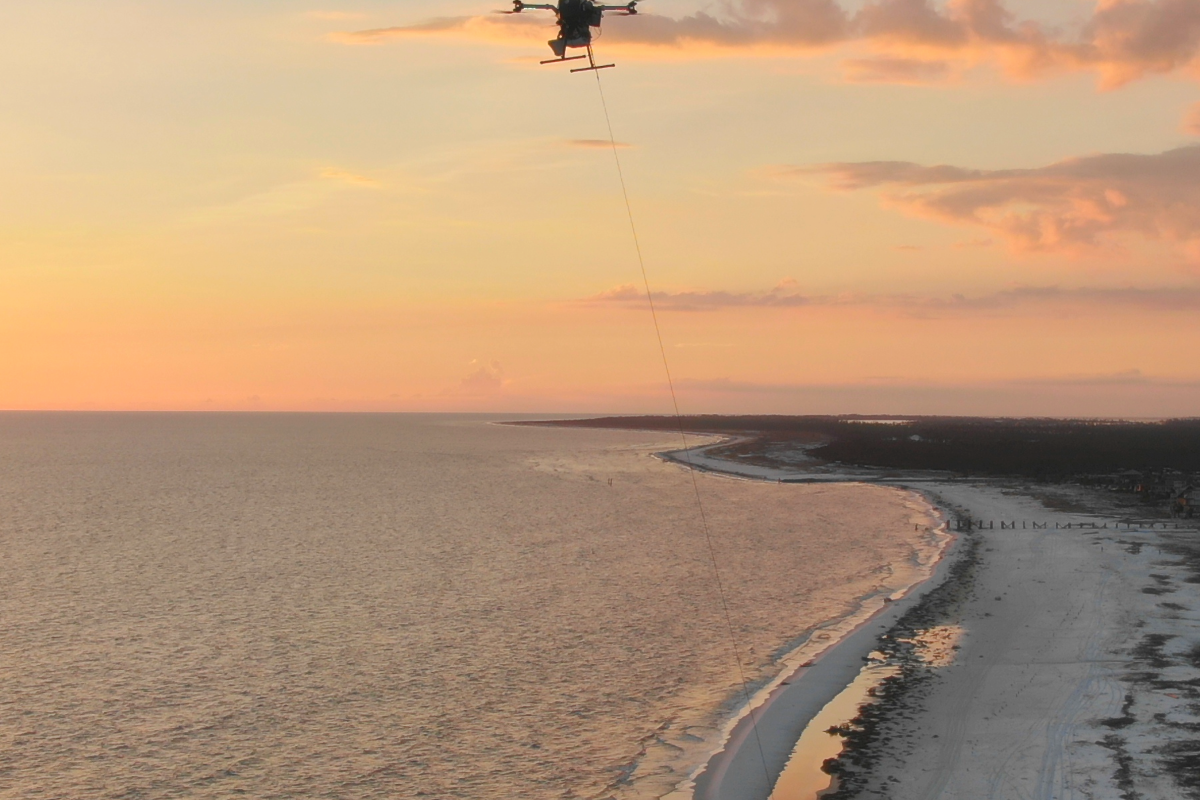
Consider temporary telecommunications coverage following a natural disaster.
When ground infrastructure is damaged or unavailable, an elevated communications platform can help restore connectivity across an affected area.
The objective isn’t to fly a complicated route or continuously reposition the aircraft. It’s to establish a reliable elevated position and maintain the necessary communications equipment overhead.
The same principle applies to persistent surveillance, event security, border operations, and temporary networking infrastructure.
For these applications, remaining stationary can be more valuable than autonomous movement.
This is where tethered unmanned aerial systems offer a different approach.
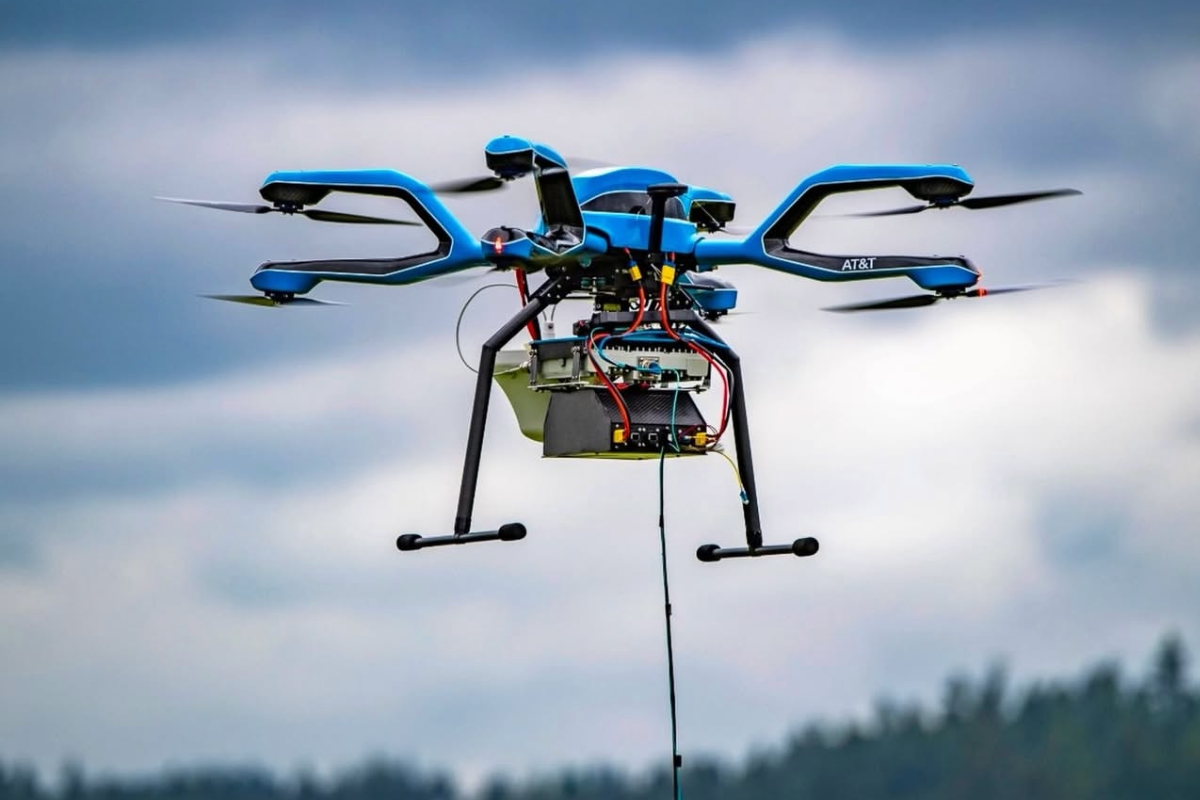
Rather than relying exclusively on onboard batteries, tethered systems receive continuous power from a ground station. Depending on the configuration, the tether can also provide a secure pathway for data and communications.
At USaS, our LEAP product line was developed around this concept.
Systems such as the LEAP Solo 5K and LEAP Solo 10K are designed to support substantial payloads while maintaining an elevated position for extended periods. With continuous ground power and high-capacity data transfer, the aircraft becomes more than a flying platform.
It becomes a piece of deployable infrastructure.
And in many applications, that is precisely what operators need.
The Ground System Deserves Just as Much Attention as the Aircraft
One of the consequences of focusing heavily on autonomy is that the aircraft itself often becomes the center of the conversation.
Yet an unmanned aerial system is only as useful as the infrastructure supporting it.
Power delivery, communications, payload integration, ground control, and data backhaul all influence what an operator can accomplish.
Consider an aircraft carrying communications equipment several hundred feet above the ground.
Elevating that equipment may improve its ability to establish connections across a wider area or overcome certain ground-level obstructions.
But getting the equipment into the air is only part of the requirement.
The system must also provide sufficient power to operate the payload, maintain the aircraft’s position, and move information between the elevated equipment and the networks or personnel that need it.
USaS has developed LEAP ground systems to address these requirements.
Beyond supplying continuous power, LEAP systems can support connections to communications infrastructure including LEO and GEO satellites, fiber, microwave, and other backhaul technologies.
This allows the elevated platform to function as part of a larger communications network rather than operating as an isolated aircraft.
For operators, that integration can be considerably more valuable than adding another autonomous flight feature.
It also raises an important point about where innovation should be directed.
If the objective is to provide reliable communications for an extended period, improving the power system, payload integration, or network connection may produce a greater operational benefit than improving the aircraft’s ability to navigate independently.
Automation and Autonomy Are Not the Same Thing
None of this suggests that operators should be required to manually control every aspect of a tethered system.
In fact, reducing operator workload remains an important part of developing practical unmanned technology.
USaS’s LEAP Tactical system, for example, incorporates automated takeoff, landing, and hover capabilities, allowing operators to deploy and maintain an elevated platform without continuously managing every flight adjustment.
Designed for highly mobile personnel and first responders, LEAP Tactical can be deployed and retrieved within approximately 10 minutes.
The system is designed to provide persistent elevated surveillance and communications support while reducing the complexity associated with maintaining an aircraft overhead.
That is a meaningful application of automation.
But there is a distinction between automating the tasks necessary to operate a system and pursuing complete aircraft autonomy as an objective in itself.
Automation can reduce workload, improve consistency, and simplify deployment.
Autonomy can allow an aircraft to make decisions and perform tasks with less direct human involvement.
Both have value, but neither should be treated as the ultimate measure of operational capability.
The question should always be whether the technology improves the operator’s ability to accomplish the intended task.
What Nearly a Decade in the Field Has Taught Us
USaS began demonstrating tethered drone technology in 2017.
Since then, our systems have supported operations involving telecommunications providers, government agencies, military organizations, and emergency response efforts.
Our deployment history includes Hurricane Maria in 2017, Hurricane Ian in 2022, the Maui wildfires in 2023, and multiple hurricane response efforts in 2024.
These experiences have reinforced the importance of looking beyond individual aircraft capabilities.
Real-world requirements involve more than successfully launching a drone.
Operators must account for changing conditions, payload requirements, communications availability, deployment logistics, personnel, and the possibility that an operation will need to continue longer than originally anticipated.
A system that performs exceptionally well during a controlled demonstration may encounter entirely different demands during an extended deployment.
And while advanced autonomy may help address some of those demands, others require improvements in power delivery, system integration, endurance, and operational flexibility.
This is why we believe the future of unmanned systems cannot be measured by autonomy alone.
The aircraft is one component of a much larger operational solution.
The Future Isn’t Necessarily Less Autonomous. It’s More Purposeful.
Autonomous technology will continue to play an important role in the evolution of unmanned aerial systems.
There are applications where independent navigation, automated decision-making, and reduced human involvement provide significant advantages.
But there are also applications where operators need something fundamentally different.
They need an aircraft that can remain elevated for extended periods. They need the ability to support heavier or multiple payloads. They need dependable communications, secure data transfer, and systems that can integrate with existing infrastructure.
And they need equipment that performs reliably outside controlled demonstrations.
At USaS, our approach has been to develop tethered unmanned aerial systems around those operational requirements, combining persistent flight capability with the power, payload support, and communications infrastructure needed to make an elevated platform useful.
We believe the industry’s next major advancements will come not simply from making drones more autonomous, but from making unmanned systems more capable of solving real problems.
Because the ultimate measure of a drone’s value isn’t how much it can do without an operator. It’s how much it enables that operator to accomplish.
Learn more about the LEAP product line and USaS’s approach to persistent aerial systems at https://unmannedsas.com/