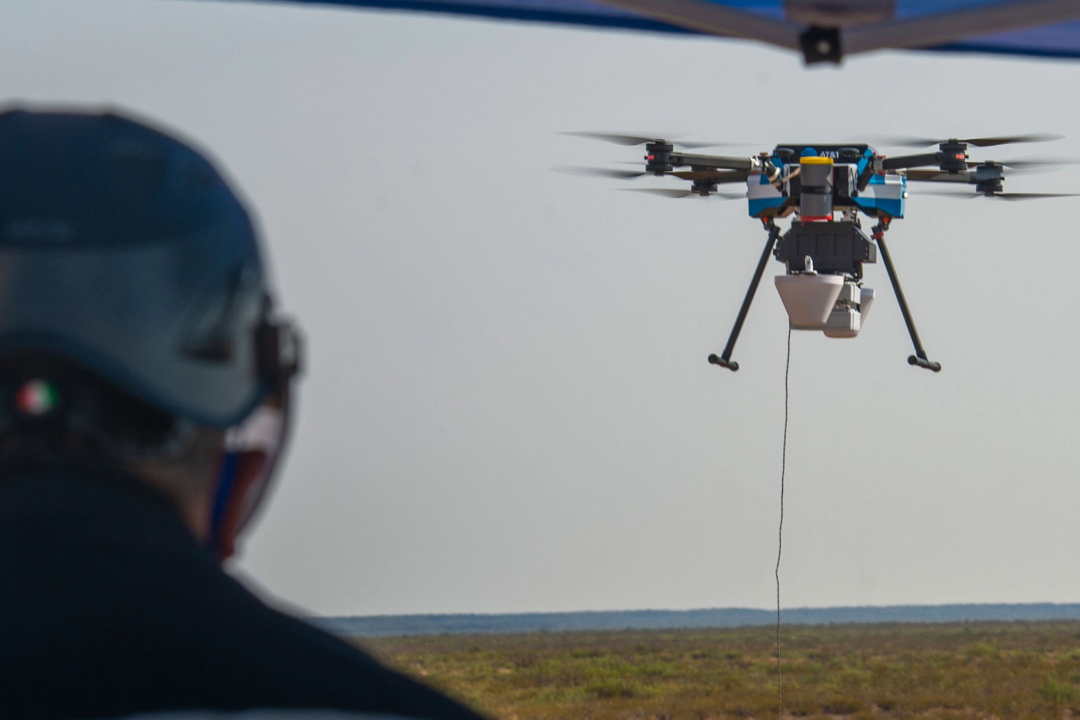
For most people, the word “drone” still brings to mind a fairly simple operating cycle: launch, fly, complete the task, return, recharge or replace the batteries, and launch again.
Tethered drones change that equation.
By providing continuous power from the ground, a tethered unmanned aerial system can remain airborne for extended periods while maintaining a fixed elevated position. Depending on the system, the tether can also provide a secure pathway for data and communications between the aircraft and the ground. The result is something that begins to function less like a traditional battery-powered drone and more like rapidly deployable aerial infrastructure.
At Unmanned Systems and Solutions (USaS), that concept is at the center of the LEAP product line, which ranges from the highly mobile LEAP Tactical to heavy-lift systems including the LEAP Solo 5K, LEAP Solo 10K, and LEAP Solo 20K. Different configurations are designed for different requirements, but they share an important advantage: the ability to keep useful capability elevated for far longer than a conventional battery cycle.
So what can you actually do with a tethered drone that doesn’t have to keep coming down?
1. Restore Communications After a Disaster
When hurricanes, wildfires, floods, and other disasters damage terrestrial infrastructure, restoring communications quickly can become a major challenge. Building or repairing a permanent tower takes time. An aerial system can provide another option.
A tethered drone can elevate communications equipment above obstacles and terrain, creating a temporary aerial communications platform that can remain in position for extended periods.
This isn’t simply theoretical for USaS. LEAP technology has supported real-world deployments associated with Hurricane Maria, Hurricane Florence, Hurricane Michael, Hurricane Ian, Hurricane Beryl, Hurricane Helene, Hurricane Milton, and the Maui wildfires.
Instead of waiting for infrastructure to be rebuilt before putting capability back into the area, the infrastructure can temporarily go into the air.
2. Maintain Persistent Overwatch
Many surveillance requirements don’t end when a battery reaches 20%.
Whether supporting public safety, border operations, force protection, disaster response, or another extended operation, there are situations where maintaining an elevated view for hours is far more valuable than repeatedly launching an aircraft for short windows of coverage.
This is one of the fundamental roles behind LEAP Tactical Overwatch. The portable system can maintain ISR and communications capabilities up to 400 feet above ground level, with up to four hours of operation using its ground battery power option or extended operation when connected to an external power source.
For operators, the advantage isn’t simply staying airborne longer. It’s avoiding unnecessary interruptions in the capability the aircraft is providing.
3. Create a Temporary Communications Tower
A tethered drone doesn’t have to be thought of primarily as a flying camera.
Put communications equipment in the air and the aircraft can effectively become a rapidly deployable elevated communications node.
USaS LEAP systems are designed to support communications applications including LTE/5G, tactical radios, and other networking technologies. Elevating that equipment can help extend coverage and provide line-of-sight advantages without requiring a permanent tower or mast at the location.
The LEAP Solo 5K combines 5 kW of available power for the aircraft and payloads with up to 21 pounds of customer payload capacity and secure high-bandwidth data transfer. For larger requirements, LEAP Solo 10K and LEAP Solo 20K extend the concept into increasingly heavy-lift applications.
The drone becomes more than an aircraft. It becomes a place to put infrastructure.
4. Support Large Events
Large public gatherings create a temporary problem: thousands of people can converge on one area while security, communications, and situational-awareness requirements increase at exactly the same time.
A persistent aerial platform can provide capability for the duration of the event rather than operating around repeated battery changes.
USaS’s operational history includes deployments supporting events such as the Super Bowl and the Dogtown St. Patrick’s Day Parade in St. Louis, demonstrating how tethered aerial systems can extend beyond military and disaster-response environments.
Concerts, sporting events, festivals, public gatherings, and other temporary events can all create situations where rapidly deployable elevated capability has value.
5. Operate Where RF Emissions Are a Problem
Sometimes staying airborne isn’t the only challenge. How the aircraft communicates can matter just as much.
LEAP Tactical Cloak is designed for environments where conventional air-to-ground RF communications may be undesirable or unavailable. Its hybrid tether incorporates fiber, allowing command-and-control and payload data to travel through the tether rather than requiring a standard RF connection between the aircraft and operator.
That creates a fundamentally different operating option.
Instead of broadcasting the aircraft’s C2 and payload data through the air, the tether itself becomes the pathway between the aircraft and ground system. For RF-sensitive or contested environments, that can be a significant capability.
6. Follow a Target After Hours of Overwatch
Persistence and mobility don’t always have to be mutually exclusive.
A tethered aircraft may spend hours watching an area, but circumstances can change quickly. An operator may suddenly need the aircraft to leave its fixed position.
That requirement is the idea behind LEAP Tactical Pursuit.
Pursuit provides the persistent capability of the Overwatch configuration while adding the ability to disengage the tether and transition into untethered flight. The aircraft can remain elevated while persistence is required, then pursue a target when mobility becomes more important.
Instead of choosing between a persistent tethered system and a mobile conventional drone before deployment, operators can have access to both modes.
7. Build an Aerial Network
One tethered drone can provide an elevated node. Multiple systems can begin to create something much larger.
USaS has experience deploying LEAP systems as part of meshed networks carrying voice, video, and data. Multiple elevated platforms can help create or extend communications and information networks across an operational area.
That changes the way tethered drones can be viewed.
Rather than treating every aircraft as an independent sensor, tethered platforms can become pieces of a broader communications and data architecture. Persistent aerial nodes can support connectivity between personnel, sensors, command centers, and other systems while remaining elevated for extended periods.
In that role, the value isn’t necessarily what one drone can see. It’s what an entire network can connect.
8. Put Capability Where Permanent Infrastructure Can’t Go
Some environments simply aren’t good places for permanent infrastructure.
The requirement may exist for only a few hours or days. The location may change. Terrain may make construction impractical. A disaster may have destroyed existing infrastructure. Personnel may need to move quickly. Or building a permanent tower may simply make no sense for the situation.
This is where the broader LEAP family becomes especially useful.
LEAP Tactical is designed around portability and rapid deployment for highly mobile operators. LEAP Solo 5K provides a heavy-lift platform for extended operations. LEAP Solo 10K expands available power and lifting capability for larger requirements, while LEAP Solo 20K extends the LEAP concept into ultra-heavy-lift applications.
The specific aircraft, payload, power requirement, and configuration may change, but the underlying idea remains the same: put capability hundreds of feet into the air without first having to build something hundreds of feet tall.
The Drone Is Only the Beginning
The most interesting thing about tethered drones may not be the fact that they’re tethered.
It’s what becomes possible when landing every 30 or 40 minutes is no longer treated as a fundamental limitation of the system.
A drone can become persistent overwatch. A temporary communications tower. An aerial network node. Disaster-response infrastructure. A platform that operates without conventional air-to-ground RF communications. Or, with LEAP Tactical Pursuit, an aircraft capable of transitioning from persistent overwatch to mobile flight.
USaS has developed the LEAP Tactical, LEAP Solo 5K, LEAP Solo 10K, and LEAP Solo 20K around these kinds of requirements, combining persistent aerial operations with different levels of mobility, power, data transfer, and lift capability.
Because once an aircraft can stay where it’s needed, the more interesting question isn’t how long it can fly.
It’s what you can do with it while it’s up there.