When organizations evaluate a new drone program, the conversation almost always begins with the aircraft itself. Procurement teams compare purchase prices, advertised flight times, payload capacities, sensors, and autonomous features. Manufacturers compete to offer longer endurance, higher payload limits, and increasingly sophisticated technology. Budgets are approved based on specifications, and the assumption is that the largest expense has already been accounted for.
In reality, the purchase price of the drone is often one of the smallest costs a program will ever incur.
The true cost of a drone program reveals itself over months and years of operation. It appears in interrupted missions, idle personnel, repeated deployments, battery management, maintenance schedules, additional equipment, operator training, and operational limitations that were never obvious during procurement. These expenses rarely appear on an invoice, yet they ultimately determine whether a drone program delivers meaningful operational value or becomes an expensive asset that spends more time preparing to fly than accomplishing the mission.
Organizations that evaluate only the aircraft frequently end up paying far more than expected—not because the drone failed, but because the overall system was never designed around the mission.
Looking Beyond the Purchase Price
Buying a drone is relatively straightforward. Operating one successfully is far more complicated.
Every deployment requires trained operators, transportation, batteries, charging infrastructure, maintenance, replacement components, communications equipment, and operational planning. Each of these elements consumes time, manpower, and resources before the aircraft ever leaves the ground.
As drone programs mature, organizations often discover they need additional personnel simply to keep aircraft operational. Batteries must be rotated and charged. Equipment must be transported between locations. Flight crews must constantly monitor remaining endurance while simultaneously focusing on the mission itself.
None of these costs appear on a specification sheet.
Over time, these operational expenses often exceed the initial investment in the aircraft itself.
Downtime Is More Expensive Than Hardware
One of the most overlooked costs in any drone program is downtime.
Whenever an aircraft lands to replace batteries, capability disappears.
Surveillance stops. Communications are interrupted. Situational awareness is reduced. Personnel on the ground either continue operating without aerial support or wait for the aircraft to return to station.
In a controlled product demonstration, this interruption appears insignificant. The drone lands, batteries are replaced, and the demonstration resumes.
Real-world missions are very different.
Disaster response does not pause because an aircraft needs power. Border security does not become less important after forty minutes. Search and rescue operations rarely conclude according to battery schedules. Military operations certainly do not wait for equipment to recharge.
Every interruption creates operational risk. Every return flight creates another period where valuable information is no longer being collected.
The cost is not measured in minutes of flight—it is measured in capability that no longer exists when it is needed most.
Complexity Becomes Its Own Expense
Many organizations assume the solution to limited endurance is simply deploying more drones.
In practice, this often creates an entirely new set of problems.
More aircraft require more pilots, more batteries, larger charging infrastructure, additional transportation space, increased maintenance, more spare parts, and greater coordination between crews. Instead of simplifying operations, complexity begins to multiply.
Managing multiple aircraft that continuously rotate through charging cycles demands significantly more personnel than maintaining one persistent aerial capability.
Every additional aircraft becomes another potential failure point.
As drone programs scale, operational complexity frequently becomes the limiting factor—not aircraft performance.
Heavy Lift Magnifies the Problem
Heavy-lift operations make these challenges even more apparent.
Payloads consume power, and larger payloads consume considerably more. Whether carrying communications equipment, multiple ISR sensors, counter-UAS technologies, or specialized government payloads, battery endurance decreases as payload weight increases. The missions requiring the greatest capability often experience the shortest flight durations simply because the aircraft is carrying more equipment.
Organizations often focus on maximum payload specifications without considering how quickly those payloads reduce operational endurance.
The result is a platform capable of carrying the required equipment but unable to remain on station long enough to maximize its operational value.
Designing Systems Around the Mission
The most successful drone programs are not built around aircraft.
They are built around missions.
At USaS, this philosophy has shaped the development of the entire LEAP product family. Rather than designing drones that simply fly longer, every LEAP platform is designed to reduce operational interruptions, minimize complexity, and maximize mission capability.
For long-duration commercial, public safety, and critical infrastructure operations, the LEAP Solo 5K provides 5 kW of continuous power, supports payloads up to 21 pounds, and delivers secure 20 Gbps fiber connectivity, allowing operators to maintain communications, ISR, and other mission-critical payloads without constantly cycling aircraft on and off station. As payload requirements increase, the LEAP Solo 10K expands that capability with 10 kW of power and support for payloads up to 50 pounds, making it well suited for demanding government and defense applications. Looking even further ahead, the LEAP Solo 20K extends the same philosophy into the super heavy-lift category with support for payloads up to 150 pounds, ensuring operators no longer have to choose between endurance and capability.
Not every mission, however, requires a heavy-lift platform.
For military units and first responders operating in dynamic environments, mobility can be just as important as persistence.
That is why USaS developed LEAP Tactical.
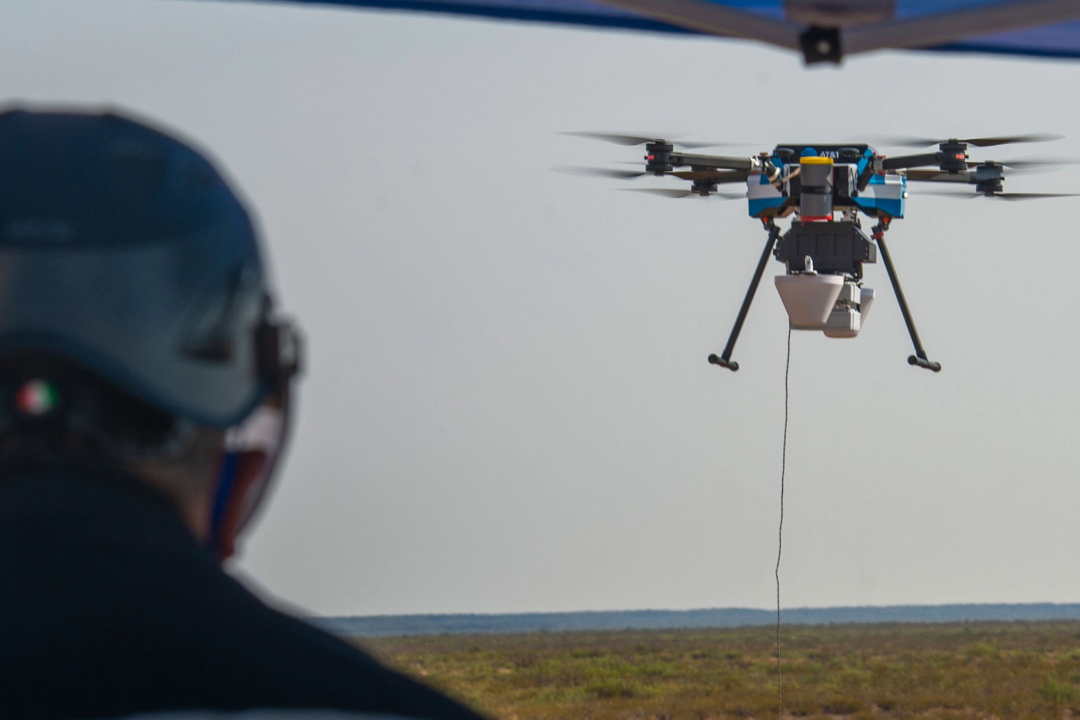
Designed to fit inside a ruggedized hard case and deploy in approximately ten minutes, LEAP Tactical provides persistent elevated surveillance and communications while remaining highly mobile. Operators can configure the platform for Overwatch, maintaining continuous ISR and communications above an area of interest; Pursuit, allowing the tether to disconnect so the aircraft can follow a moving target; or Cloak, which routes command-and-control and payload data through a fiber-optic tether, eliminating the air-to-ground RF signature for operations in contested environments. Each configuration was developed to solve a specific operational challenge while maintaining the same objective: keeping capability on station instead of repeatedly bringing it home.
Although these products serve different users and mission sets, they are built on the same principle.
The mission should determine when operations end—not the battery.
Experience Reduces Cost
Another hidden expense in any drone program is operational inexperience.
Many systems perform exceptionally well during carefully controlled demonstrations where the weather is predictable, operators are familiar with the environment, mission duration is fixed, and support personnel are readily available.
Operational deployments rarely provide those advantages.
Weather changes unexpectedly. Objectives evolve. Communications requirements increase. Payloads change. Operators rotate. Missions extend well beyond the original plan.
Organizations with extensive real-world operational experience understand these variables because they have encountered them repeatedly—not in demonstrations, but during hurricanes, disaster response, border security operations, military exercises, public safety missions, and critical infrastructure deployments. That operational experience reduces risk, minimizes downtime, and prevents costly mistakes that are impossible to identify in a controlled product demonstration. USaS has spent years supporting real-world deployments alongside organizations including AT&T, DHS/CBP, FEMA, and numerous commercial and government partners, building solutions based on operational reality rather than laboratory conditions.
Measuring the Right Cost
The biggest cost in a drone program is rarely the aircraft itself.
It is the cost of interrupted missions.
It is the cost of additional personnel required to maintain continuous operations.
It is the cost of managing batteries instead of accomplishing objectives.
It is the cost of operational complexity, repeated deployments, and capability that disappears exactly when it is needed most.
Organizations that evaluate drone systems solely by purchase price often discover these costs only after deployment.
Organizations that evaluate complete mission capability understand that the most valuable system is not necessarily the one with the longest advertised flight time or the lowest acquisition cost.
It is the one that delivers the greatest operational value over the lifetime of the mission.
Because in the end, the biggest cost in your drone program isn’t the drone.
It’s everything that happens after takeoff.