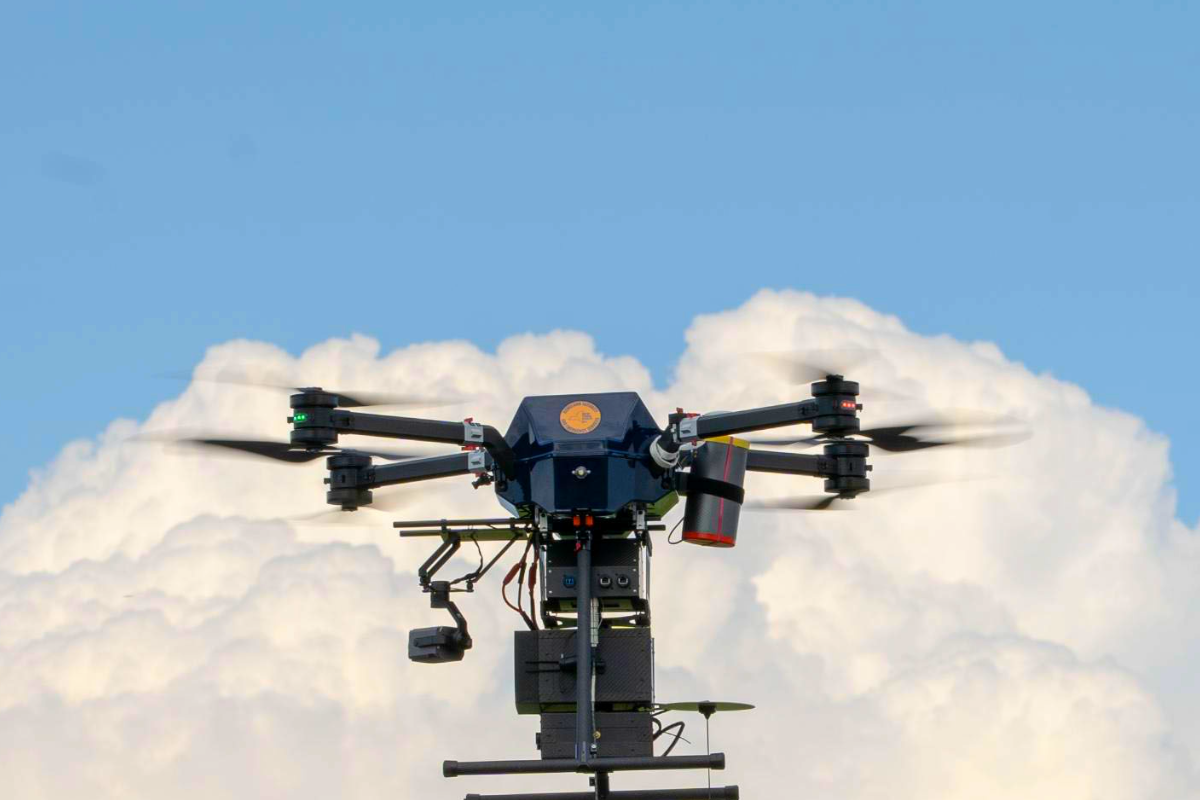
The technology being carried by unmanned aerial systems has changed dramatically.
What was once primarily a flying camera can now serve as an elevated platform for sophisticated ISR sensors, tactical radios, LTE and 5G equipment, communications relays, networking hardware, and other specialized payloads. In many cases, the technology carried beneath the aircraft is ultimately more important—and more valuable—than the aircraft itself.
So why would we trust an onboard battery to determine how long that technology stays in the sky?
At Unmanned Systems and Solutions (USaS), we don’t.
That is one of the fundamental ideas behind the LEAP product line. LEAP tethered systems deliver power from the ground to the aircraft and its payloads, allowing persistent aerial capabilities to remain elevated without being constrained by the flight time of a conventional onboard battery. The tether can also provide a secure pathway for high-speed data, turning the aircraft into part of a larger aerial infrastructure system rather than a vehicle operating against a battery countdown.
From the highly mobile LEAP Tactical to heavy-lift systems including the LEAP Solo 5K, LEAP Solo 10K, and LEAP Solo 20K, the objective is not simply to put increasingly capable technology into the sky. It is to provide the power, data connectivity, payload capacity, and supporting infrastructure necessary to keep it there.
The Payload Has Changed the Value of the Aircraft
There was a time when evaluating a drone largely meant evaluating the aircraft itself. Flight characteristics, range, speed, camera quality, and battery life provided a relatively straightforward picture of what the system could accomplish.
That equation is much more complicated today because the aircraft increasingly serves as only one component of a larger system.
A customer may need an ISR sensor elevated to establish persistent surveillance. Another may need communications equipment positioned hundreds of feet above the ground to expand coverage. An operator may need tactical radios, networking hardware, or multiple payloads operating simultaneously.
In each case, getting the aircraft airborne is only the beginning. The actual objective is to make the capability carried by the aircraft available where it is needed and for as long as it is needed.
This distinction matters because a payload can remain useful long after a conventional battery-powered aircraft needs to land. The requirement for surveillance does not disappear because a battery is depleted. A communications requirement does not conveniently pause while an aircraft lands, batteries are replaced, and the system is relaunched.
The technology may still be capable of doing exactly what it was designed to do. The problem is that the aircraft carrying it can no longer keep it where it needs to be.
That is the problem LEAP was designed to address.
Heavy Lift Makes the Power Question Even More Important
The challenge becomes even more pronounced as payloads become heavier.
Heavy-lift drones create opportunities to elevate equipment that smaller aircraft simply cannot carry. But with a conventional battery-dependent system, adding payload weight also increases the demand placed on the aircraft’s available energy.
That creates an important contradiction: the more capability you put in the sky, the harder it can become to keep it there.
Payload capacity tells an operator how much technology an aircraft can lift. It does not necessarily tell them how long that technology can remain useful once it gets there.
USaS approaches that problem differently through LEAP.
The LEAP Solo 5K is a heavy-lift tethered system designed for extended operations, providing 5 kW of power for the aircraft and payloads while supporting up to 21 pounds of customer payload. The system also provides up to 20 Gbps of secure data transfer, allowing LEAP to support applications where moving information can be just as important as providing power.
For applications requiring additional capacity, the LEAP Solo 10K increases available power to 10 kW and is designed for substantially heavier customer payloads. Beyond that, the LEAP Solo 20K extends the concept into an ultra-heavy-lift platform, providing 20 kW of power and supporting customer payloads up to 150 pounds.
The progression from 5 kW to 10 kW to 20 kW is important because USaS is not simply building increasingly large tether systems. The LEAP product line is designed around increasingly demanding airborne payload requirements.
As sensors, communications systems, networking equipment, and other technologies become larger and more power-intensive, the infrastructure keeping them airborne has to evolve with them.
LEAP Is More Than a Power Cable Connected to a Drone
It is easy to reduce tethered UAS to a simple concept: plug a drone into the ground so it can fly longer.
That dramatically understates what a complete tethered system needs to accomplish.
A basic LEAP system includes the aircraft, electronics and tether modules, a proprietary tether, and a ground controller. The electronics and tether modules manage power for the aircraft and payloads, route signals and data, manage the tether, facilitate backhaul, and provide integration for customer payload equipment. The tether itself can carry both power and fiber for data, while the ground controller provides UAV and payload control and telemetry.
That architecture changes the role of the aircraft.
Instead of treating the drone as a self-contained vehicle that must carry the energy necessary to complete its flight, LEAP makes the aircraft part of a larger aerial infrastructure system.
For many applications, that is the more relevant way to think about persistent UAS.
The question is no longer simply whether an aircraft can carry a particular payload. The questions become whether the system can power it, move its data, integrate it, maintain its position, support its communications requirements, and remain available for the duration of the operation.
Those are system-level problems, and solving them requires more than extending battery life.
Persistence Does Not Have to Mean Giving Up Mobility
There are applications where heavy-lift persistence is the priority, but there are also environments where operators need persistent elevation without giving up the ability to move quickly.
That requirement led USaS to develop LEAP Tactical, a smaller and highly mobile extension of the same tethered architecture.
LEAP Tactical is designed as an all-in-one tethered solution for Group 1 drones and can be deployed and retrieved within approximately 10 minutes. The system supports operations up to 400 feet AGL.
LEAP Tactical can provide four hours of operation using its optional battery-based ground power system or extended operation when connected to external power such as 120VAC, a vehicle, vessel, or another available supply.
That distinction is important.
The battery-based option is on the ground. LEAP Tactical is not simply sending up a conventional drone and trusting its onboard flight battery to determine how long the capability can remain elevated. External power can support extended operations without repeatedly bringing the aircraft and its payload back down for battery changes.
More importantly, LEAP Tactical was designed around different ways operators may actually need to use an elevated platform.
Overwatch provides persistent elevation for ISR and communications payloads, allowing those capabilities to remain on station while optional high-bandwidth links can backhaul payload data to remote sites and command centers.
Pursuit adds the ability for the aircraft to disengage from the tether and pursue a target when mobility becomes necessary.
Cloak uses a hybrid tether to provide command-and-control and payload data transmission through the tether itself, allowing the aircraft to operate without relying on conventional air-to-ground RF communications.
Those configurations illustrate the broader philosophy behind LEAP. Persistence should not be treated as a single-use capability. Different customers need different combinations of endurance, mobility, payload capacity, communications, data transfer, and operational flexibility.
The product line is designed to provide those combinations rather than forcing every requirement into the same aircraft and power architecture.
The Real Question Is What Needs to Stay in the Air
One of the easiest mistakes to make when discussing drones is focusing almost entirely on the aircraft.
But consider what happens when a drone carrying an ISR sensor lands for a battery change.
The interruption is not merely a gap in aircraft flight time. It is a gap in the surveillance capability that aircraft was providing.
The same principle applies to communications. If the aircraft is serving as an elevated communications node, bringing the aircraft down also brings the node down. If it is carrying networking hardware, that equipment loses its elevated position. If multiple systems on the ground are depending on an airborne payload, the consequences of landing extend far beyond the drone itself.
This is why USaS has spent years developing LEAP around both aircraft endurance and payload support.
LEAP systems have supported payload categories including communications equipment, ISR and counter-drone technologies, BVLOS and multi-unit operations, fronthaul and backhaul equipment, and mobile deployment applications. USaS tethered systems have also been used in real-world deployments involving major telecommunications providers and U.S. government customers.
That experience matters because persistent aerial infrastructure is not simply a theoretical use case for USaS.
USaS technology has been involved in deployments associated with hurricanes including Maria, Florence, Michael, Ian, Beryl, Helene, and Milton, as well as the Maui wildfires, government exercises, border operations, major events, communications testing, and other real-world applications.
These are precisely the kinds of environments where the distinction between getting airborne and staying operational becomes important.
A Drone Can Become Infrastructure
The most interesting thing about tethered UAS may ultimately be that, after enough time in the air, the drone begins to serve a role that looks less like a conventional aircraft and more like deployable infrastructure.
A tower is useful because of what elevation allows it to do. It can place communications equipment, sensors, antennas, or other technology above obstacles and provide coverage over an area.
But permanent infrastructure requires planning, construction, fixed locations, and time.
A tethered UAS approaches elevation from the opposite direction.
Bring the system to the location. Deploy it. Elevate the required technology. Supply power from the ground. Move data through the tether or available backhaul. When the requirement changes, retrieve the system and deploy it somewhere else.
That is a fundamentally different way to think about aerial systems.
LEAP Tactical addresses that concept where portability and rapid deployment matter. LEAP Solo 5K provides heavy-lift capability for more demanding payloads. LEAP Solo 10K expands the available power and payload envelope further. LEAP Solo 20K pushes into ultra-heavy-lift applications where the equipment being elevated may bear little resemblance to the payloads traditionally associated with small drones.
Together, they represent a product line built around the idea that the value of an unmanned aircraft should not end when its battery does.
Stop Designing the Requirement Around the Battery
Battery-powered aircraft will continue to play an enormous role in unmanned aviation.
When an aircraft needs to travel significant distances, rapidly reposition, inspect multiple locations, deliver something, map an area, or perform countless other mobile tasks, batteries provide exactly the freedom those applications require.
But that does not mean every aerial requirement should be designed around them.
When the objective is persistent ISR, communications, networking, elevated sensing, temporary coverage, or another capability that benefits from remaining in one general area, repeatedly landing the entire system because its energy source is onboard deserves scrutiny.
Especially when the technology being brought down may be worth far more than the aircraft carrying it.
USaS built the LEAP product line around a different question. Instead of asking only how much payload a drone can carry or how far an aircraft can fly before returning, LEAP asks how the entire airborne capability can be supported for the duration it is actually needed.
That means power. It means payload capacity. It means secure data transfer. It means tether management. It means backhaul. It means integration.
And depending on the application, it can mean anything from a highly mobile Group 1 system to an ultra-heavy-lift platform capable of elevating substantial equipment.
We continue to put more sophisticated and more valuable technology into the sky.
At USaS, we don’t trust an onboard battery to decide when it has to come back down. That’s why we built LEAP.